Among the Cis-Sutlej states of the Punjab, Malerkotla occupies a unique position. It is the only Muslim-ruled principality in a landscape dominated by Sikh chiefs. Its Nawabs were Sarwani Pathans — descendants of Shaikh Sadr ud-Din Jahan, a Sufi saint who received a jagir of fifty-eight villages near Ludhiana from Sultan Bahlol Lodi in 1454. Their coins, struck from the mid-eighteenth century until 1947, followed the universal pattern of the Cis-Sutlej states: the legend and date of Ahmad Shah Durrani frozen in perpetuity, the individual Nawab identified only by the initial letter of his name — the 'ain (ع) — hidden within the sin of Julus.
These are not Sikh coins — and for that reason they are excluded from SikhCoins.in. But they are Punjab coins, struck alongside and in constant interaction with the Phulkian rupees of Patiala, Nabha and Jind. To understand one family of coins is to understand the other. This page presents the coinage of the Nawabs of Malerkotla as documented by Captain R. C. Temple in his landmark monograph of 1889, supplemented by more recent scholarship.
The Founding of Malerkotla
The founder of the Kōtlā family at Mālār was Shaikh Sadr ud-Din Jahan, a Sarwani Afghan and Sufi saint of considerable celebrity. Sultan Bahlol Lodi gave him a daughter in marriage in 1454 with a dowry of land. He left three sons — Hasan by the Lodi princess, and 'Isa and Musa by a local Rajput wife from Kapurthala. The present ruling family descends from 'Isa; the descendants of Hasan became the mujawar (shrine-keepers) of Sadr Jahan's tomb.
The fifth in descent from Sadr Jahan, Bayazid Khan, founded the fortified town of Kōtlā near Mālār in 1657 and is reckoned the first Nawab. He earned the Mughal emperor Aurangzeb's gratitude by saving his life from a tiger attack, receiving the privilege to build a defensive fort and recognition as an independent ruler. According to family tradition, he summoned both a Sufi saint and a Hindu sadhu to lay the foundation stone — a deliberate act of communal harmony that would define the character of the state for three centuries.
Sher Muhammad Khan and the Sikh Connection
The most celebrated Nawab in Sikh memory is Sher Muhammad Khan (r. 1672–1712), Bayazid Khan's grandson. When the younger Sahibzade — Fateh Singh and Zorawar Singh, the nine- and seven-year-old sons of Guru Gobind Singh — were ordered to be bricked alive by the governor of Sirhind, Wazir Khan, in 1705, Sher Muhammad Khan was present in the court and raised a vehement protest. He declared that the execution contravened the dictates of Islam and the laws of the Prophet. According to the Mahan Kosh, when Guru Gobind Singh learned that the Nawab of Malerkotla had raised his voice, he blessed the house of the Nawab, declaring that its roots would remain forever green.
That blessing held. In 1947, when the rest of Punjab was engulfed in communal violence during Partition, Malerkotla remained an oasis of peace. The reigning Nawab, Ahmad Ali Khan, declared that for every Sikh or Hindu who perished within his principality, four Muslims would die in atonement. Not a single life was lost. This is the enduring legacy of Sher Muhammad Khan's protest in 1705.
The Coinage — Ahmad Shah's Legend Frozen in Time
The right to coin was granted to Malerkotla by Ahmad Shah Durrani. Temple records that Bhikan Khan, eldest son of Nawab Jamal Khan, received the right to mint in his own name from the Durrani during the latter's campaigns against the Sikhs. He was killed in 1763/64 — but the coinage he initiated survived him for nearly two centuries.
The fundamental characteristic of the Malerkotla coinage — shared with Patiala, Nabha, Jind and Kaithal — is that from the day Ahmad Shah granted the right to coin, nearly 140 years before Temple's writing, the legend, date and mint never changed. The dies were cut and re-cut over and over again, but to all outward appearance the coins were always those of Ahmad Shah minted in the fourth year of his reign (AH 1164 / AD 1751) at Sarhand (Sirhind). The only distinguishing feature of each Nawab's coinage was his personal mark — in the case of Malerkotla, invariably the initial letter of his name in Arabic script.
Obverse: Hukm shud az qadiri-la-yazal
Sikka-yi sahib-i-zaman Ahmad Shah
Reverse: Zarb Sarhand sanah 4 julus maimanat manus
"By the command of the Eternal God, coin of Ahmad Shah, the Lord of the Age.
Struck at Sarhand, year 4 of the auspicious reign."
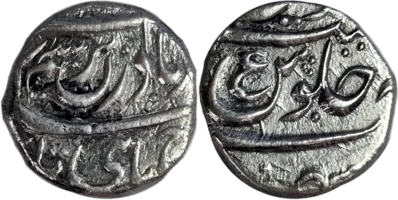
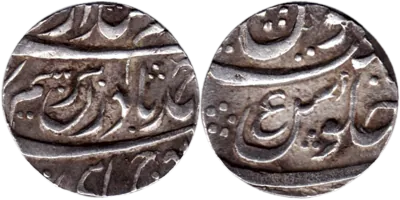
Temple observes that the Malerkotla Nawabs used the initials of their names as distinguishing marks. The Sidhu/Spink catalogue (2022) adds a critical visual diagnostic: Malerkotla coins always carry a large flower stem on the left side of the obverse — a feature that immediately separates them from the otherwise similar Patiala, Nabha and Jind rupees. The only exceptions are the coins of 'Umr Khan and Ataullah Khan, which lack this flower. On the reverse, the initial of the ruling Nawab's name appears within or above the Suad (ص) of Julus. Twenty-two Nawabs ruled Malerkotla in total, but only eleven had coins minted during their reigns.
The Nawabs and Their Coins
| Nawab | Reign | Denominations | Notes |
|---|---|---|---|
| Bhikan Khan Rustam-i-Hind |
1755–1763 | No coins known | Received right to coin from Ahmad Shah Durrani, 1761. Killed at Kakra fighting Amar Singh of Patiala. |
| Bahadur Khan (Regent) |
1763–1766 | No coins known | Killed at Mansurpura fighting Amar Singh of Patiala. |
| 'Umr Khan (Regent) |
AH 1180–1195 (1766–1780) |
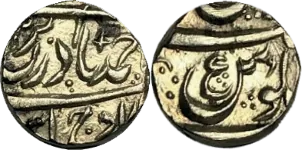
1 Rupee MK 1 (KM C#5) 10.67g, 17–18mm |
The finest coins in the series. AH 1180, 1183, 1188 dated. Variants MK 1da & 1xb lack the Suad symbol. No flower stem on obverse. |
| Asadullah Khan (Regent) |
AH 1195–1198 (1780–1784) |
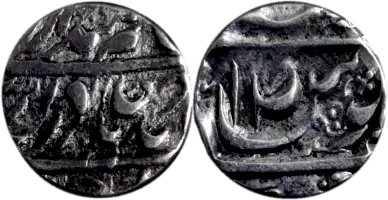
1 Rupee MK 6 (KM C#10) 10.68–10.98g, 17mm |
Undated. Temple fig. 29. |
| Ataullah Khan (Regent) |
AH 1199–1225 (1784–1810) |
1 Rupee MK 11 10.67g, 17–18mm |
AH 1213 dated. No flower stem. Nearly lost state to Ranjit Singh; restored under British protection. |
| Wazir Khan | AH 1225–1236 (1810–1821) |
1 Rupee MK 16 10.98g, 17mm |
AH 1230 dated. |
| Amir Ali Khan | AH 1237–1262 (1821–1846) |
¼ Rupee (MK 21, 2.68–2.90g) ½ Rupee (MK 22, 5.35–5.80g) 1 Rupee (MK 23, 10.39–10.80g) |
Initial: smaller 'ain (ع) above left of Suad. VS 1896 date on some rupees. First to issue fractional denominations. |
| Mehboob Ali Khan (Sube Khan) |
AH 1262–1274 (1846–1857) |
¼ Rupee (MK 31, 2.63g) ½ Rupee (MK 32) 1 Rupee (MK 33, 11.01g) |
Initial: smaller mim (م) above left of Suad. Assisted British in both Anglo-Sikh Wars and Mutiny. |
| Sikandar Ali Khan | AH 1274–1288 (1858–1871) |
¼ Rupee (MK 40, 2.70–2.74g) ½ Rupee (MK 45, 5.35–5.80g) 1 Rupee (MK 50/55/60, 10.05–10.78g) |
Initial: sin (س) above left of Suad. Star and dots within the "S" of Julus. Multiple varieties with 4-dot, 8-dot and 11-pointed star rosettes. |
| Ibrahim Ali Khan | AH 1288–1326 (1871–1908) |
¼ Rupee (MK 70, 2.59–2.64g) ½ Rupee (MK 75, VS 1902) 1 Rupee (MK 80, 10.62–10.82g) |
Reverse: Alif and Be (for Ibrahim) above Julus. AH 1292, 1311 dated. Kuka attack 1872. |
| Ahmad Ali Khan KCSI, KCIE |
AH 1326–1366 (1908–1947) |
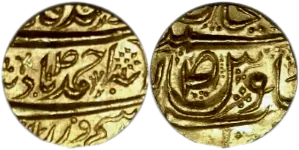
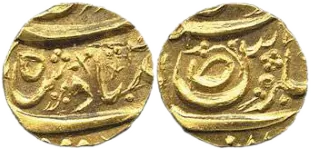
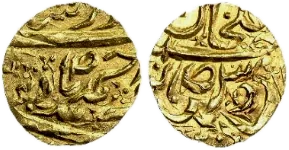
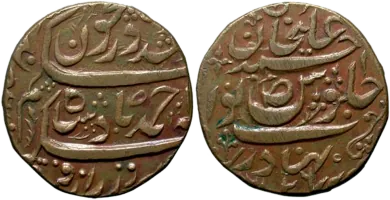
½ Paisa (MK 85) 1 Paisa (MK 90) 1 Rupee (MK 95/100) Nazarana 2 Rupees (MK 105, 22g, 30mm) ¼ Mohur (MK 110, 2.94g) ½ Mohur (MK 115, 5.94g) |
Only Nawab to inscribe his full name on coins, replacing the frozen Ahmad Shah legend. Nazarana reverse: "Zadand Sikka Daulat ba-Fazl-i-Rab Kareem Ba-hukm Walee-i-Maler Kotla bar Seem" — struck to commemorate his Dastarbandi (24 Sept 1908) and installation (6 Jan 1909). Gold mohurs are presentation pieces. |
Specimens
Coins of the Nawabs of Malerkotla.
'Umr Khan (Regent) · AH 1180–1195 (1766–1780)
Asadullah Khan (Regent) · AH 1195–1198 (1780–1784)
Ataullah Khan (Regent) · AH 1199–1225 (1784–1810)
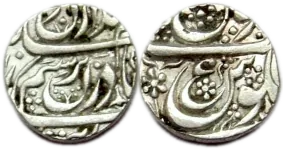
Nawab Wazir Khan · AH 1225–1236 (1810–1821)
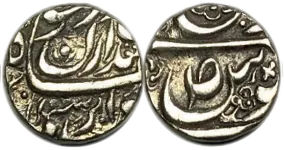
Nawab Amir Ali Khan · AH 1237–1262 (1821–1846)
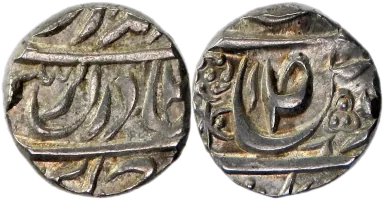
Nawab Mehboob Ali Khan (Sube Khan) · AH 1262–1274 (1846–1857)
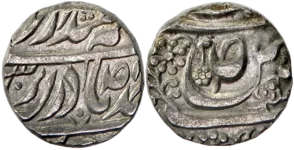
Nawab Sikandar Ali Khan · AH 1274–1288 (1858–1871)
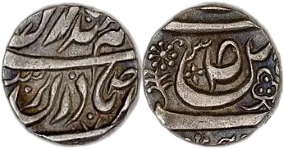
Nawab Ibrahim Ali Khan · AH 1288–1326 (1871–1908)
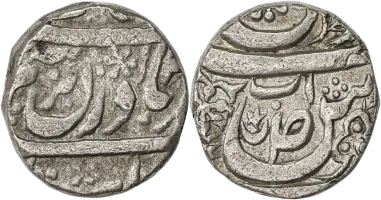
Nawab Ahmad Ali Khan KCSI, KCIE · AH 1326–1366 (1908–1947) — Silver
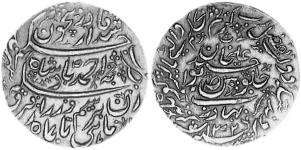
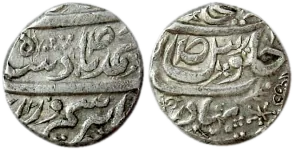
Nawab Ahmad Ali Khan — Gold Issues
Nawab Ahmad Ali Khan — Copper Issues
Weight, Value and the Mint
Temple records a steady depreciation in weight across the successive Nawabs of Malerkotla — a pattern entirely consistent with the general theory of the evolution of semi-barbarous coinages:
| Nawab | Reign | Weight |
|---|---|---|
| 'Umr Khan | 1768–78 | 9 miskal 4 ratti |
| Amir Khan | 1821–45 | 9 miskal 2 ratti |
| Mahbub 'Ali (Sube) Khan | 1845–59 | 8 miskal 4 ratti |
| Sikandar 'Ali Khan | 1859–71 | 8 miskal 2 ratti |
| Ibrahim 'Ali Khan | 1871– | 8 miskal 1 ratti |
Extensive frauds on the part of the mint masters — twice detected in alloying the silver — had depreciated the Kōtlā rupee to only 12 anas (three-quarters of a rupee) in value. The Kōtlā mint issued its coins on the same primitive lines as Patiala and Nabha. Temple's brother-in-law, Khansahib 'Inayat 'Ali Khan (brother of Nawab Ibrahim 'Ali Khan), provided the die impression reproduced in his monograph — giving us the most complete representation of the Malerkotla legend available.
The Ruling House of Malerkotla
└ Bayazid Khan (r. 1657–1672) — Founded Fort Kōtlā; first Nawab
└ Firuz Khan (r. 1659–1672)
├ Sher Muhammad Khan (r. 1672–1712) — Protested execution of Sahibzade; blessed by Guru Gobind Singh
│ ├ Ghulam Husain Khan (r. 1712–1717) — Deposed by brother
│ └ Jamal Khan Rustam-i-Hind (r. 1717–1762) — Allied with Ahmad Shah Durrani; killed fighting Ala Singh of Patiala
│ ├ Bhikan Khan (r. 1762–1763/64) — Received right to coin; killed by Sikhs
│ │ └ Muhammad Wazir 'Ali Khan (r. 1766–1809 with interruptions)
│ │ └ Wazir Khan (r. 1809–1821)
│ │ └ Amir Khan (r. 1821–1845) — Last Ra'is; first Nawab title from British
│ │ └ Mahbub 'Ali (Sube) Khan (r. 1845–1859)
│ │ └ Sikandar 'Ali Khan (r. 1859–1871)
│ ├ Khan Bahadur Khan (Regent, 1764–1766) — Killed by Amar Singh of Patiala
│ ├ 'Umr Khan (Regent, 1768–1778) — Best coins in the series
│ ├ Asadu'llah Khan (1778–1782)
│ └ 'Ata'ullah Khan (1782–1809) — State nearly lost to Ranjit Singh
│ └ Rahmat 'Ali Khan → Dilawar 'Ali Khan → Ibrahim 'Ali Khan (r. 1871–1908)
│ └ Ahmad 'Ali Khan (r. 1908–1947) — Full name on coinage; protected Malerkotla during Partition
│ └ Iftikhar 'Ali Khan (r. 1947–1948) — Last Nawab; merged into PEPSU
Note: The succession at Malerkotla followed a complex seniority system among the sons of Jamal Khan, with the title passing between brothers before reverting to the senior line. The British replaced this with strict primogeniture from Wazir Khan onwards.
Attributing Malerkotla Coins
The diagnostic for attributing Malerkotla rupees rests on three features, refined across Temple (1889) and the Sidhu/Spink catalogue (2022):
1. The flower stem. Sidhu/Spink identify a large flower stem on the left side of the obverse as the primary marker distinguishing Malerkotla coins from other Cis-Sutlej issues. This is present on all rulers except 'Umr Khan and Ataullah Khan.
2. The initial letter above the Suad. Each Nawab placed the Arabic initial of his name above the left side of the Suad (ص) — the letter forming part of the word Sahib in the obverse legend. A smaller 'ain (ع) indicates Amir Khan (AH 1237–1262); a smaller mim (م) indicates Mehboob Ali Khan (AH 1262–1274); a sin (س) indicates Sikandar Ali Khan; and Alif-Be (اب) indicates Ibrahim Ali Khan.
3. The rosette within Julus. From Sikandar Ali Khan onwards, distinctive rosette patterns — four dots, eight dots, an eleven-pointed star, or a star with crescent — appear within the Persian letter "S" of Julus on the reverse. These provide a secondary diagnostic for separating late-period issues.
The Kotla Rupee (Kotla Rupiyah) was the local name for the Malerkotla silver rupee. Temple records steady weight depreciation across reigns, and the Sidhu/Spink catalogue confirms that weights ranged from 10.67g ('Umr Khan) down to 10.05g (Sikandar Ali Khan) — with the notable exception of Mehboob Ali Khan's heavier 11.01g rupees.
References
Temple, R. C. "The Coins of the Modern Native Chiefs of the Panjab."
The Indian Antiquary, November 1889, pp. 821–841.
Griffin, Sir Lepel. Rajas of the Punjab.
Khansahib 'Inayat 'Ali Khan. A Description of the Principal Kōtlā Afghans.
Lahore: Civil and Military Gazette Press, 1882.
"Malerkotla." The Royal Ark (www.royalark.net/India/malerk.htm).
Rodgers, C. J. "Coins of Ahmad Shah Abdali." JASB, Part I, Vol. LIV (1885), p. 75.
Sidhu, Saran Singh & Dalwinder Singh. Coins of the Sikh Empire, Punjab and the
Cis-Sutlej States. Spink, 2022.
Read about the Cis-Sutlej States on SikhCoins.in ↗
© 2026 Jeevandeep M Singh · Ludhiana, Punjab